
This report documents the “Most Wanted” DXpedition to Montserrat (157) by 13DA016 Mike.
 It details the extensive planning, travel, equipment, on-air ops, and propagation experiences over the course of a week-long stay on one the Caribbean region’s most elusive DXCC entities.
 The report includes insights into local conditions, QRN challenges, and strategies for reaching stations across the Americas, Europe, Asia, and Oceania, as well as highlights of the island itself—from its volcanic landscapes to cultural and musical landmarks.
Here’s his report…

Planning the Trip
 Taking the declining sunspot cycle into account, the West Indies would likely make a great destination again, with rewarding band conditions almost all year round…
Having operated multiple times from Turks & Caicos (248), St. Barth (346), as well as once from Sint Eustatius (349) and the Bahamas (121), the island of Montserrat (157) soon came into closer consideration.
 Without spending too much time checking charts, I once more trusted my senses, which told me that “The Emerald Isle” was a sought-after destination on 11m. In my humble opinion, recent activities had not at all satisfied the hungry DXer’s needs.
Reason enough for me to pack my gear and jump on board a plane into the sun again!
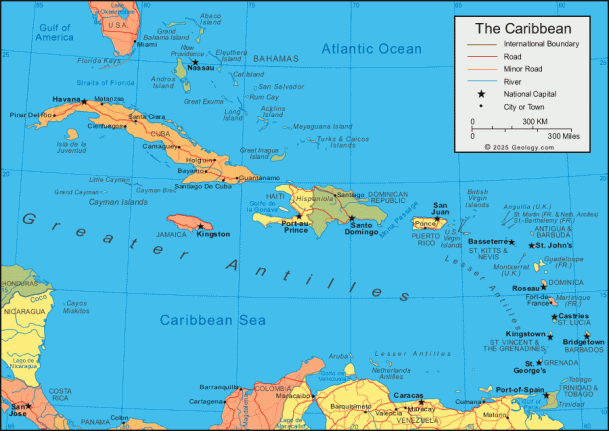
The journey took me from Frankfurt, in the German state of Hesse, nonstop to Antigua (120) – the gateway to other islands in this very beautiful part of the world…
Here, I had to spend one night prior to hopping on a Britten-Norman Islander prop plane for the 25-minute flight across the Caribbean to the volcanic island of Montserrat.

Equipment & Travel Logistics
My standard radio equipment of the past years would come into operation again…
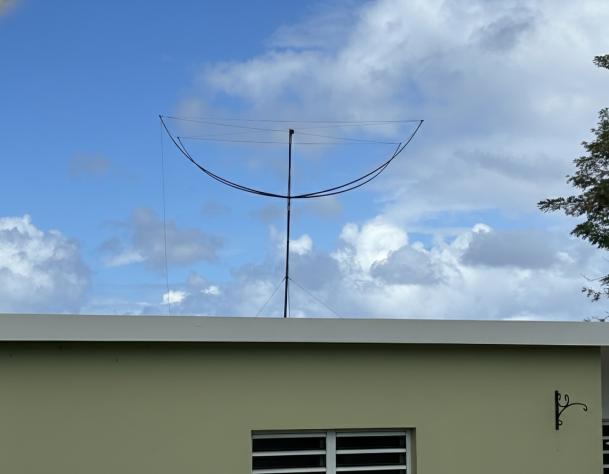
 It included a far-travelled Yaesu FT-450D transceiver, a Skypper Light Antenna, a 10 m Spiderbeam mast, a pileup-proven KL-503 amplifier, SEC 1235 PSU, as well as all the usual necessary hardware like fuses, power cables, low-loss coaxial cable, and much more.
With all this I was exactly at the baggage weight limit of 25 kg for my checked bags and, as usual, my transceiver and the amp went into my carry-on bag, which has never caused problems in decades of radio travels.
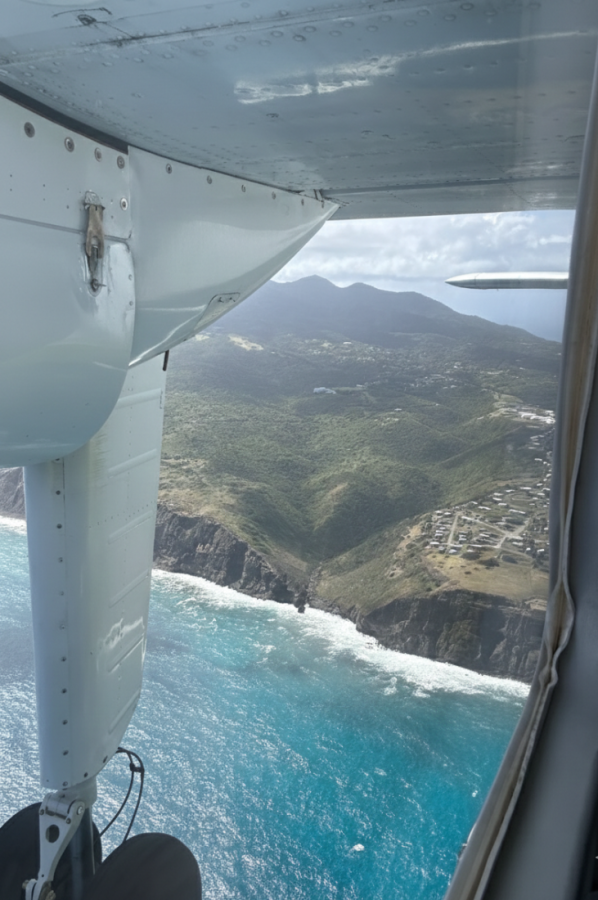
However, baggage weight is something different on these tiny inter-island planes…
 Almost as expected, I was charged $60 on the flight from Antigua to the British Overseas Territory of Montserrat, while nothing at all on the way back.
Approaching Montserrat Airport, squeezed into the propeller plane like sardines in a tin can with seven other passengers, was exciting and reminded me of the legendary St. Barth approaches I knew from the past.
Not exactly the best thing for people who fear flying.
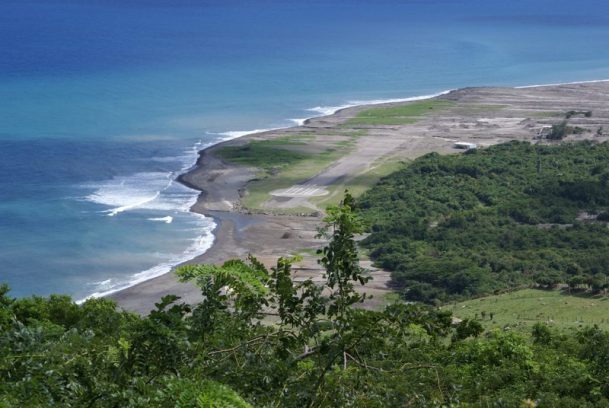
Arrival & First Impressions
 In the weeks before, I had spent hours on Earth View and Airbnb, looking for the ultimate spot on the island that would suit my needs…
This is essential when planning a DX trip. I really love doing this and every time, upon arrival, it feels like having been there before.
My intensive research also included reading through all reviews of possible accommodations, since this helps a lot to learn as much as possible about the place in question.
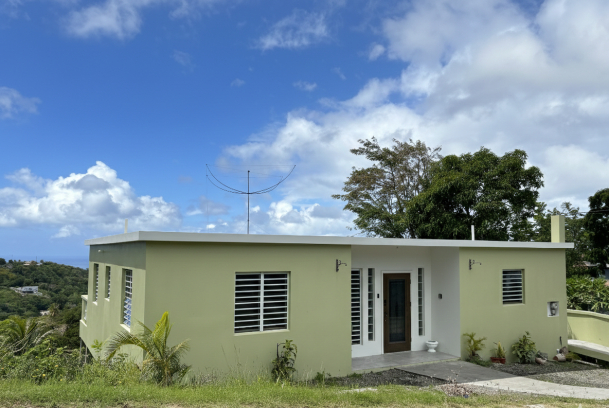
Upon arrival at Air Studios, I was immediately met by my host, who turned out to be a lottery jackpot…
 We had been in touch for weeks and I almost felt at home there while still in Germany.
She was incredibly helpful, organized a rental car, and took care of filling the refrigerator with essentials.
Simply overwhelming.

As always, I tend to go all in and therefore didn’t mention anything about building antennas and transmitting on shortwave beforehand, because that very often leads to concerns…
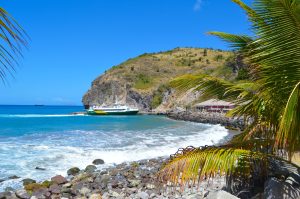 It’s much better to explain everything once on site.
People in the West Indies are extremely relaxed, gentle, and helpful.
And the host’s feedback was: “You’re free as a bird. Do whatever you want.”
Soon after arrival at my cottage, the antenna went up on the mast.

Setting Up & QRN Surprise
My accommodation was a complete cottage in the village of St. John’s, located on a ridge overlooking the Caribbean, with free takeoff in all relevant directions…
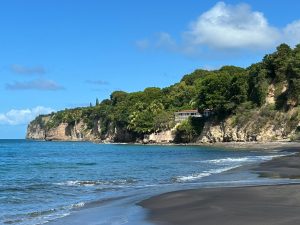 I was very optimistic.
One unpredictable thing — never mentioned in any Airbnb offer and becoming a serious threat for us radio nerds — is man-made noise (QRN).
I’d never had that problem before, with one exception in St. Barth back in 2013 when I had to stop working on 40 m once the LED lights of the cottage colony went on.
Switching on the transceiver for the very first time is always special. Blood pressure and adrenaline at maximum levels.
There it was: S5–7 QRN. A shock.
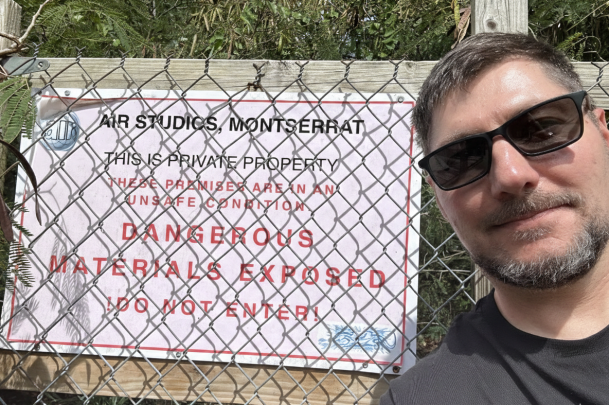
Fuming, I grabbed an ice-cold Carib Lager, walked around to check whether the source was within my cottage…
 Obviously, it wasn’t.
With no immediate neighbors, I became a bit lost. A second Carib helped.
Luckily, QRN toward Europe — the biggest DX market — could be kept under control using the DSP filtering of my Yaesu FT-450D transceiver.
Still, pulling weaker signals out of this mess would become a challenge. Peak QRN levels were toward North America and Far East Asia. Not nice.
No surrender. Time to get on air.

First QSOs & Opening to Europe
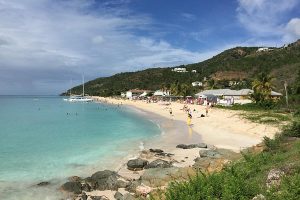 After calling CQ as 157DA0, I didn’t have to wait long for the pileup…
24EK011 Gregorio from Panama City was first in the log.
Shortly after, plenty of stations from all around the Americas followed.
3DA001 Tulio was the first Brazilian, followed by 32DA002 Manu, 12DA101 Mario, and 34DA010 Saul from the Canary Islands.
The first from the US were 2AT041 Joe and 2DA120 Tom…
 Among the first ten QSOs were also the Aussie big guns 43DX234 Tom and 43A33 Jim.
41DA981 Giovanni brightened my face with his broadcast-style signal from the ‘Land of the Long White Cloud’.
Old friends like YL 34AT116 Belen and 34AT192 Nando were also among the first again.
Because I arrived mid-afternoon, I didn’t expect Europe on day one — just the Americas and Oceania. The real European run was yet to come.

Caribbean Routine
The next morning followed my approved Caribbean routine..
 Climbing out of bed at daybreak, preparing a peanut butter and jelly sandwich plus black coffee on the porch, enjoying magnificent views across the awakening island and Lesser Antilles chain.
Tropical birds provided the soundtrack.
After a windy night, I raised the antenna mast to maximum height to see the skypper sore over of the Leeward Islands.
Fully exposed, I enjoyed the trade winds, making any non-existent aircon obsolete.
Later that day I applied the guyings, leaving the antenna untouched for the remainder of my stay.
In the West Indies you can almost set your alarm clock to band openings…
 First voices usually arrive from the British Isles, France, and the Iberian Peninsula while propagation slowly crawls eastward into Europe — around 7:00 am local time.
Coffee is essential. Shortly after, there’s no chance anymore.
The pileup started instantly. QSO rates went machine-gun style. Europe also acts as long-path to Asia and Down Under, and I was thrilled to receive feedback from 43U045 Grant over several days. On the same path, 153IR102 Lars and 153AT777 Jan entered the log.
Several hundred QSOs in less than 24 hours brought satisfaction and confidence. The trip was already worthwhile — QRN couldn’t spoil it.

Power Cuts & DX Magic
 During the first two days I learned to cope with QRN using DSP filtering and slight antenna detuning…
Lower signal, but also less noise.
Then came a blessing: a general power outage.
The entire island went dark.
When power returned, QRN was gone. Obviously, the noise source required manual restart — which didn’t always happen.
 This created precious quiet windows.
On the second-last day, QRN never came back after another outage. Pure luck. That’s when Japan, Australia, New Zealand, French Polynesia, New Caledonia, Hawaii, and many more made it into the log.
I was thrilled.
Island Life & Musical Pilgrimage
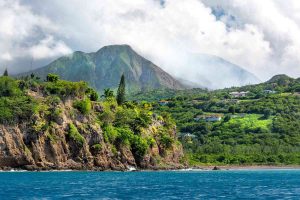 Montserrat is a true Caribbean gem — diverse with stunning landscapes…
A British Overseas Territory, it was badly hit by Hurricane Hugo in 1989 and later devastated by Soufrière Hills’ volcanic eruptions from 1995 onwards.
The southern part is now an exclusion zone.
 Plymouth lies buried under about 12 m of pyroclastic material. Today, roughly 4,500 inhabitants remain.
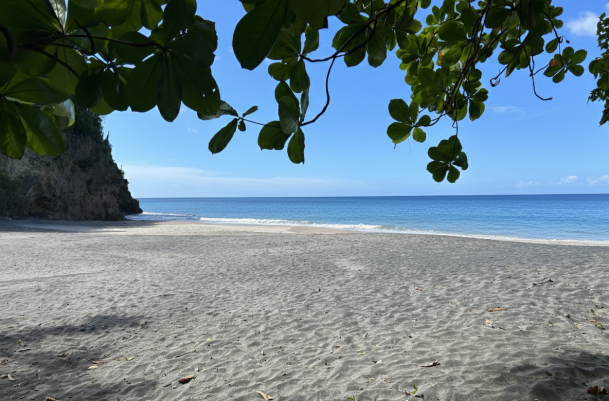
Exploring locally is essential: hiking, dark beaches, driving around lush rainforest.
Apart from its northern tip, the island is green and tropical — straight out of a 1980s Bacardi ad.
The island offers lush rainforest, dark volcanic beaches, and breathtaking viewpoints.

 A Pilgrimage for Music Lovers
Being mad about music, I knew AIR Studio Montserrat from The Police and Dire Straits records.
Destroyed by Hugo, it still felt magical to stand there where Sting once swam in the pool.

DX Highlights

DX from the Caribbean is like catching fish in a barrel — especially toward Europe…
Once Europe closes around noon, afternoons bring Pacific, Americas, and Asia.
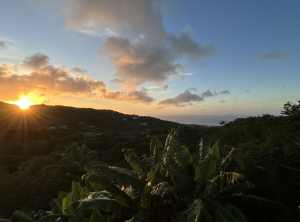 Special moments included finally working 43DA001 Darren and 43DA1112 Leonie after many attempts. Never give up on 11 m.
Evenings brought chats with old friends: 2AT116 Mickey, 2AT019 Emilse, 9AT119 Alex, and powerhouse 350DA101 Bert.
Days passed quickly. I would have loved to stay longer, but one week was optimal.

Small World
 On departure morning, my host invited me for breakfast on the beach.
Later in Antigua, reviewing photos, I realized the local musician was 157AT101 Bim. Small world.
One week on Montserrat delivered everything hoped for: strong pile-ups, rare DX, dramatic landscapes, musical history, and unforgettable human encounters.
 Another radio journey completed.
Another reminder why we do this.
Thank you all!
73 de Mike, 13DA016


Mike, Well done, both for the good report and the activation.
Patience paid off and I finally made your log.
Many thanks.
Geoff 43DA050